
Has the Stigma of Divorce Really Changed Since the 1970s?

Updated September 2026
Has the Stigma of Divorce changed in the last 50 years?
A month before I decided to separate from my ex, I called up my eldest sister and asked her, “Would you be embarrassed if I got a divorce?” At the time, I was not sure why I asked this question; it just came out of my mouth before I even knew it. Thinking back, I suspect that I needed to hear that she was going to be accepting and that I wasn’t going to be frowned upon by my family for getting a divorce after 19 years of marriage. It is quite strange that I felt this way since divorce is so prevalent in today’s society with the rate of divorce in Canada at 40% and even higher in the States. What I was fearing was the ongoing stigma surrounding divorce.

Divorcing in 1972
My mother and father got divorced in 1972. They lived in a big house in Toronto, and she was a young, stay-at-home mother with two little girls, my sister was four years old, and I was just six months old. Overnight, her life changed drastically.
If I felt embarrassed and feared the stigma during my own divorce, I can't help but wonder what it was like for my mother over 50 years ago.
Divorce in the early 1970s was rare. To put it into context, knowing a divorced family back then was about as uncommon as knowing a set of twins. I’ve only known three sets of twins in my entire lifetime, which shows just how few divorced couples existed in a community back then.
Because it was so rare, day-to-day life for divorced women was much harder. She was a struggling single mother in a society that labeled us a "broken family," where women were routinely judged and blamed for the breakdown of the marriage.
There were no support systems back then. Finding friends or dating was difficult, especially as a primary caregiver, when the only options were bars, singles' clubs, or classified ads in the local newspaper. It was a deeply lonely journey.
Today, we have access to online support groups, divorce podcasts, virtual therapy, and dedicated communities for single parents. While finding support is much easier now, the emotional transition still takes work.
Has the stigma of divorce really changed since the early 1970s
Even over 50 years after my Mom and Dad’s divorce, society still has a lingering and insidious view that divorce is wrong. Recent studies state that more than half of those who are divorced or divorcing believe there is still a stigma attached to it.
We feel this way because our beliefs and standards were put there by others, not by ourselves. Think of it this way: children are taught that successful people should study, get a career, find a suitable partner, and start a family. When people divorce, it is called a "failed marriage," and they are viewed as failures. Because our society is built around traditional families, those who divorce can easily feel like outsiders.
Because our society is built around traditional families, those who divorce can easily feel like outsiders. In fact, when someone close to us separates, it often acts as a mirror that forces us to question our own life choices, I even explored this social dynamic in my blog post, [My Best Friend is Divorcing: Should I Get One Too?].
Many will try everything to salvage a marriage just to avoid that label. When you are going through a divorce, you can feel like you've lost your footing in society and been cast aside. You might hear comments like:
"Your poor kids."
"You didn't try hard enough."
"Every marriage has its tough times—you can get through this."
All these factors and many more contribute to divorcing people still feeling judged today.

Women feel more stigma and shame than men do
Feelings of shame and stigma are more commonly felt by women than men. Women are taught that keeping a marriage together is their responsibility, we are expected to be the "glue of the family," the nurturer, the giver, and the one who sacrifices everything. We were raised to be kind, generous, and to think of others first, alongside the expectation to get married and have children.
So in my own situation, I felt ashamed and embarrassed for not living up to my "duty" as a wife and mother.
I remember talking to an older man after my divorce, and he told me he would never date a divorced woman because she "couldn't make her marriage work." I was stunned. I had no idea people still held those attitudes; I genuinely thought society had evolved past that way of thinking.
What about self stigma
When I asked my sister about being embarrassed, it was because I was experiencing self-stigma. I had internalized society's judgments, and I, too, started to believe that I had failed. I didn't want to tell anyone or discuss it with anyone, and I actively avoided people so they wouldn't find out, even though I was the one who left the marriage.
Eventually, I realized I had to work on my self-esteem and rebuild myself from the ground up to recognize that I was not a failure. I started reframing my thinking, telling myself that I actually had the courage to leave a difficult, neglectful, and abusive marriage.
It also took time to understand that divorces happen because both parties contribute to the breakdown, and I admit to my own share of that responsibility. Taking the blame entirely on my own shoulders was wrong, but it is so typical for women to absorb most of the guilt.
Because this is such a huge obstacle in post-divorce healing, I have a popular episode on my Just Separated podcast: [How to Deal with Shame and Guilt in Divorce]. In it, I share deeper insights and strategies on how to release that internalized shame and rebuild your self-worth.
Nearly Nine Years In
I wrote this post three years ago, but today I am nearly nine years into my journey of separation and divorce. Looking back, I realize that shedding the stigma isn't something that happens overnight—or even after a few years.
Research still shows that more than half of divorced people carry feelings of self-stigma and subtle judgment. I still feel it to this day, though it is much lighter than it used to be. Even nearly a decade later, I see that while society's views have softened since my mother's time, the pressure to view divorce as a "failure" hasn't completely vanished. Unlearning that stigma is an ongoing process, but choosing your peace is always worth it.
Tips for getting past shame and stigma in divorce
When going through a divorce there are two people in that marriage. Both have some responsibility for the breakdown. They may not be equal, but it is rarely one person's fault.
If you feel you are really stuck in this shameful emotion, it would be best to seek a therapist to discuss those feelings, re-evaluate your core beliefs regarding divorce and build up your self esteem again.
Shame in a divorce is when you feel like you violated someone else’s standard. It is society’s belief it doesn’t have to be yours. For example: if someone says, “all children from divorce suffer”, do you accept this or can you challenge this thought since new research states that many children of divorce learn to become more resilient, empathetic and self-sufficient. Challenge these stereotypical beliefs about shame in your own divorce.
You may feel like you are now different from your married family and friends, and they may view you differently. They may say nonsensical things like, “at your age how are you going to find someone else to date?” However it is their beliefs about divorce, not yours.
Nowadays, millions of people get divorced, you are not alone in your journey. Join divorce groups and workshops to meet new peers like yourself.
Are you a failure? People often go immediately to negative thinking since as humans, we are wired this way. Rather than ruminating about what we did not do right in the marriage, we need to reflect on the things we did right and grow from both.
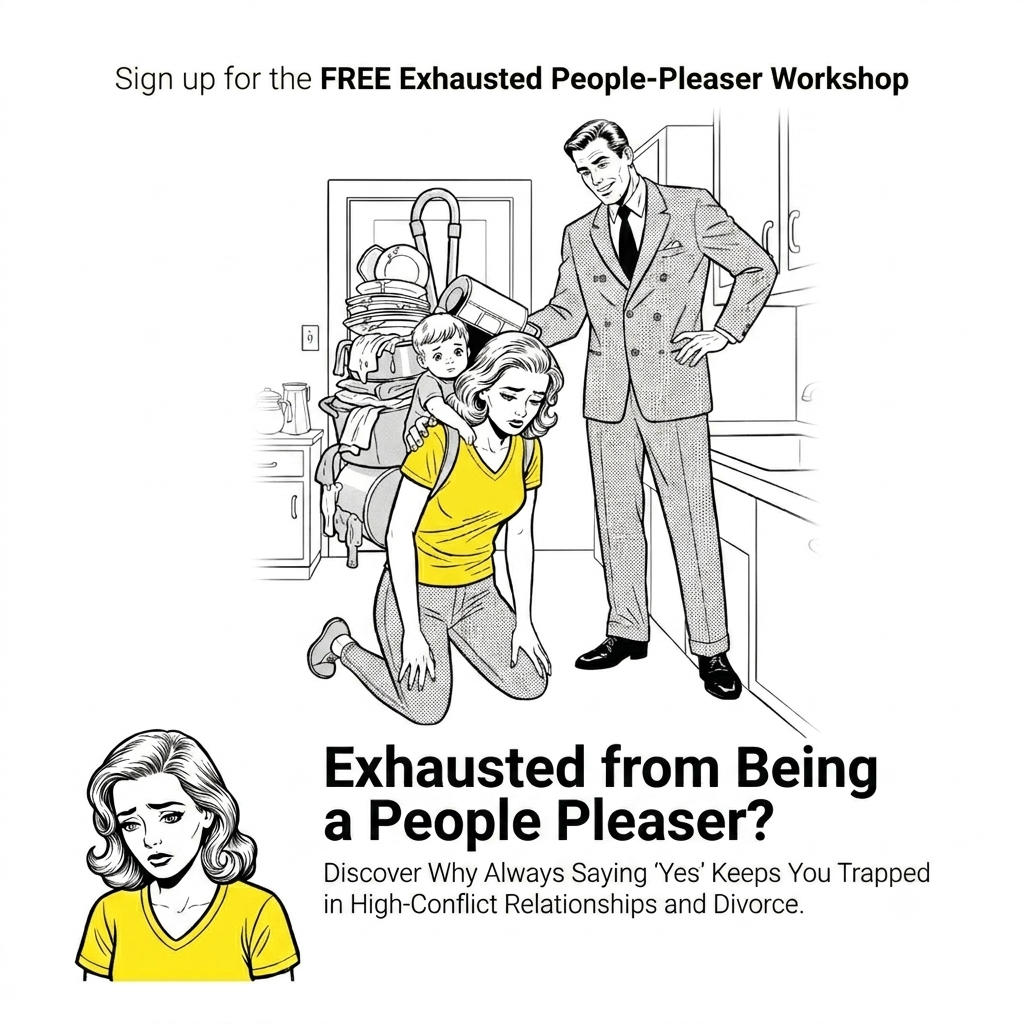
Ready to Stop Putting Everyone Else First?
Join Our Free Live Workshop: Exhausted by Peacekeeping? Breaking the Cycle of Chronic People-Pleasing
Are you ready to stop giving away your "best towels" to people who only want your silence?
Together, we will move from the fog of automatic programming into the light of conscious choice. You aren't "bad" for choosing yourself; you’re finally just coming home.
The Format: A 60-minute "Quiet Session" (no cameras required, no forced sharing) designed to dismantle the bracing reflex and release post-divorce guilt.
The Frequency: Hosted live every other month.
The Bonus: Sign up today and get your Emergency Reset Kit sent straight to your inbox immediately.
👉 [Sign Up for the Free Workshop Here]
(Click below to see our next live date and lock in your spot)